
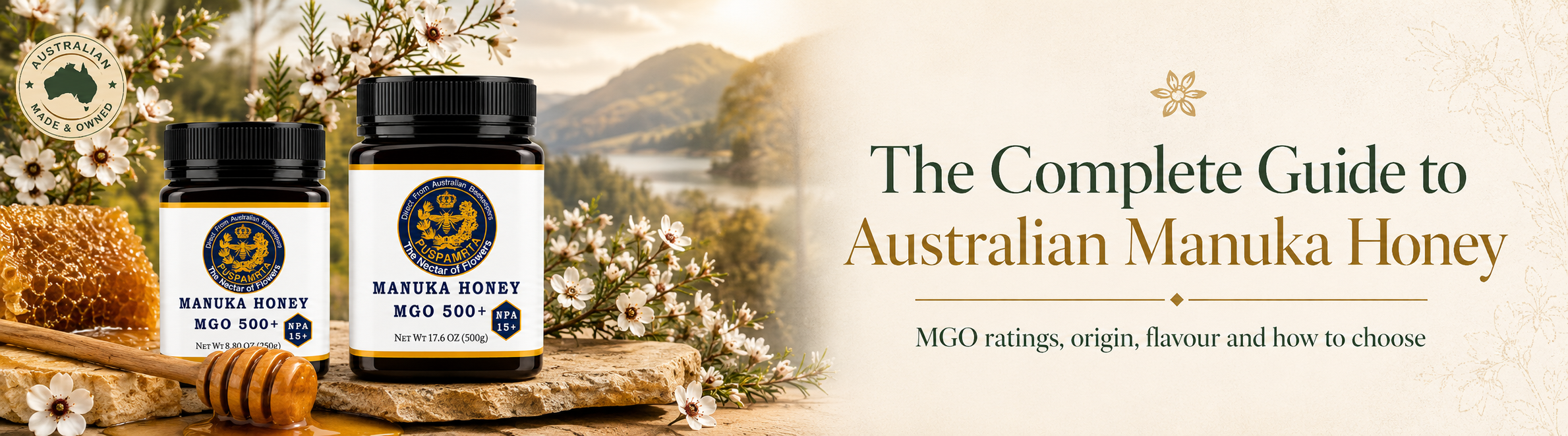
Australian Manuka honey is produced when bees collect nectar from Australian plants in the Leptospermum genus. It is known for its distinctive flavour, Australian origin and laboratory-measured grading information, especially the MGO number shown on many jars.
This complete Australian Manuka honey guide explains where the honey comes from, what MGO, DHA, NPA and UMF mean, how monofloral and multifloral products differ, what to look for on a label, and how to compare the full Puspamrta range from MGO 100+ to MGO 1600+.
The guide is educational and food-focused. A higher MGO number describes a higher measured concentration of methylglyoxal; it does not automatically make one jar the best choice for every customer or every use.
Contents
What is Australian Manuka honey?
Australian Leptospermum plants and origin
How Australian Manuka honey is produced
What does MGO mean?
MGO, DHA, NPA and UMF explained
Monofloral and multifloral Manuka honey
Quality, testing and authenticity
Taste, colour and texture
Puspamrta MGO strength comparison
How to choose a Manuka honey strength
Ways to enjoy Manuka honey
How to store Manuka honey
Australian and New Zealand Manuka honey
Why Manuka honey prices vary
Frequently asked questions
What Is Australian Manuka Honey?
[1]
The word “Manuka” is often connected in shoppers’ minds with one particular plant or one country. In practice, Australia has a broad range of native Leptospermum species growing in many environments. This gives Australian beekeepers access to different floral sources and creates natural variation between regions and harvests.
Australian Manuka honey is still honey and should be purchased and used as a food. The main commercial difference is that the jar may carry laboratory-measured information such as MGO, and sometimes another grading reference such as NPA. These numbers help customers compare labelled products more clearly than descriptions such as “strong” or “premium” on their own.
A complete buying decision should consider more than one number. Country of origin, floral source, brand, jar size, pack quantity, batch details, testing information, product presentation and intended use all matter.
Australian Leptospermum Plants and Origin
[2]
[1] This diversity is an important part of the Australian Manuka story because nectar chemistry, flowering conditions and honey characteristics can vary between species and locations.
The plant source is only one part of production. Rainfall, temperature, flowering intensity, hive placement and harvest timing also influence how much nectar is available and what the finished honey looks and tastes like. This means two authentic Australian Manuka honeys may not be identical in colour, aroma or consistency.
Natural variation should not automatically be treated as a quality problem. The important questions are whether the origin is clearly stated, whether the grading claim is supported by suitable testing, and whether the product information matches the jar being sold.
How Australian Manuka Honey Is Produced
Production begins when bees forage on flowering Leptospermum plants. They collect nectar and carry it back to the hive. Inside the hive, the nectar is transferred between bees, combined with naturally occurring enzymes and placed into honeycomb cells.
The bees reduce the moisture content until the honey matures, then cap the cells with wax. Beekeepers later remove the frames, uncap the wax and extract the honey. The honey may be strained or filtered, allowed to settle, gently warmed for handling, tested and packed.
The exact route from hive to jar can differ between producers. Some products are packed with minimal processing, while others are filtered for greater clarity or handled to create more consistent texture. These decisions affect appearance and pourability but do not replace the need for accurate origin and grading information.
Before choosing a jar, read the product page and label for the country of origin, net weight, batch information, grading system and brand details. A premium appearance is useful for gifting, but it is not a substitute for clear product information.
What Does MGO Mean in Manuka Honey?
MGO stands for methylglyoxal. On a Manuka honey label, the MGO number normally refers to the stated concentration of methylglyoxal measured in milligrams per kilogram, written as mg/kg.
For example, MGO 100+ indicates a stated methylglyoxal concentration of at least 100mg/kg, while MGO 500+ indicates at least 500mg/kg. MGO 1600+ indicates a much higher labelled concentration of at least 1600mg/kg.
[3]
The plus sign is important. It means the product is labelled as meeting or exceeding the stated number rather than being exactly equal to it. Customers should compare MGO values using the same unit and check that the number applies to the actual jar and batch being purchased.
A higher MGO value is a higher concentration statement. It can also affect product positioning and price. It should not be turned into a medical recommendation or used to assign a treatment purpose to a particular grade.
MGO, DHA, NPA and UMF Explained
MGO
[4]
DHA
DHA means dihydroxyacetone. It occurs naturally in the nectar of some Leptospermum flowers and can convert to MGO over time. DHA may therefore be examined as part of laboratory testing and authenticity assessment.
NPA
NPA means non-peroxide activity. It is an activity reference traditionally associated with a laboratory assay. Some Australian Manuka jars display an NPA value alongside MGO to give customers another labelled comparison point.
UMF
[5]
MGO, NPA and UMF should not be treated as identical labels. MGO is a concentration measurement, NPA is an activity reference, and UMF is a licensed New Zealand certification system. A product should not be described as UMF-certified unless the brand and product are entitled to use that trademark.
Monofloral and Multifloral Manuka Honey
Monofloral Manuka honey is mainly associated with one dominant Manuka floral source. This does not mean every bee visited only one flower. Bees forage freely, but the dominant nectar source gives the honey its principal botanical identity.
Multifloral Manuka honey contains Manuka nectar together with nectar from other flowering plants. Its flavour may be more layered, and its colour and texture can vary according to the wider mix of flowers available during the harvest.
[1] Shoppers should read the producer’s description rather than assuming that every jar has exactly the same floral composition.
Monofloral does not automatically mean that a jar is the best choice for every customer. Multifloral products may offer a different flavour, price and everyday-use option. The correct comparison depends on the product description and the customer’s priorities.
Quality, Laboratory Testing and Authenticity
Authentic Manuka honey cannot be confirmed by a simple home test. Colour, thickness, taste, crystallisation or whether the honey dissolves in water cannot prove botanical origin or MGO concentration.
Laboratories can test compounds connected with Manuka honey, including MGO and DHA. Depending on the testing program, other chemical markers, pollen information, moisture, HMF and general honey-quality measurements may also be considered.
[4] A jar should only claim a certification or association mark when that specific product is entitled to use it.
For practical online buying, look for a complete product name, Australian origin, clearly identified MGO number, net weight, supplier details, batch or lot information where applicable and realistic product wording. Be cautious when a page makes broad promises but provides little information about the actual jar.
A certificate of analysis can provide useful batch-level information, but the certificate must relate to the product being sold. The company name, batch identifier, tested measurement and date should be clear enough to connect the document with the jar.
What Does Australian Manuka Honey Taste Like?
Australian Manuka honey is often described as aromatic, full-flavoured and more distinctive than mild everyday honey. Depending on the floral source and harvest, it may have herbal, earthy, caramel-like, woody or slightly mineral notes.
Taste is subjective, and MGO alone does not create a guaranteed flavour. Two jars with similar MGO numbers can taste different because they may come from different Leptospermum species, locations, seasons or batches.
Colour can range from golden amber to much darker shades. Texture can also differ. Some jars pour easily, while others are thick or become more granular over time.
Crystallisation is a natural physical change and does not automatically mean Manuka honey is spoiled or adulterated. To soften crystallised honey, place the closed jar in warm water and allow it to warm gradually. Avoid boiling the honey or directly overheating a plastic jar.
Puspamrta Australian Manuka Honey Strength Comparison
The Puspamrta range provides eight clearly labelled MGO options. The table below compares their position within the range. Check each live product page for current jar sizes, pack options, price and stock availability.
| MGO strength | Position in the range | Product page |
|---|---|---|
| MGO 100+ | Introductory labelled strength for customers beginning to compare Australian Manuka honey | View MGO 100+ |
| MGO 263+ | Accessible step above the introductory strength | View MGO 263+ |
| MGO 500+ | Established premium strength for broader comparison and gifting | View MGO 500+ |
| MGO 900+ | High-strength premium selection within the Puspamrta range | View MGO 900+ |
| MGO 1000+ | Upper-range four-digit MGO selection | View MGO 1000+ |
| MGO 1282+ | Advanced upper-range labelled strength | View MGO 1282+ |
| MGO 1450+ | Vintage Grade upper-range selection | View MGO 1450+ |
| MGO 1600+ | Flagship and highest-labelled Puspamrta strength | View MGO 1600+ |
How to Choose a Manuka Honey Strength
There is no single MGO number that is automatically correct for everyone. A sensible choice should match the customer’s budget, flavour preference, experience with Manuka honey, jar-size needs and reason for purchasing.
1. For a first Australian Manuka purchase: begin with a clearly labelled introductory or accessible strength, such as MGO 100+ or MGO 263+, when the goal is to explore the flavour and product style.
2. For a premium everyday selection: compare MGO 500+ with jar and pack options that match how often the honey will be used.
3. For a high-strength purchase: compare MGO 900+ and MGO 1000+ by price, presentation, label information and current availability.
4. For an upper-range or gift purchase: compare MGO 1282+, MGO 1450+ and MGO 1600+ according to budget, brand positioning and the recipient’s familiarity with Manuka honey.
5. For multipacks: calculate the total quantity, discount and likely usage before buying a larger pack. A bigger discount only represents value when the quantity suits the buyer.
Higher MGO products generally cost more and may be selected for premium comparison, collecting or gifting. This does not mean lower strengths are poor quality. They occupy a different position in the same labelled range.
Ways to Enjoy Australian Manuka Honey
1. Enjoy a small amount directly from a clean spoon.
2. Spread it on toast, crumpets or pancakes.
3. Add it to yoghurt, oats, fruit or breakfast bowls.
4. Stir it into warm tea after the drink has cooled slightly.
5. Use it in dressings, marinades and glazes where its strong flavour suits the recipe.
6. Pair it with cheese, nuts or fruit as part of a food platter.
7. Include a premium jar in an Australian food gift or hamper.
Manuka honey has a more distinctive flavour than many mild table honeys, so a smaller quantity may provide enough sweetness and character in food. Taste the honey first before adding it to a recipe.
How to Store Manuka Honey
Keep the jar tightly closed in a clean, dry cupboard away from direct sunlight and excessive heat. Use a clean, dry spoon so that water, crumbs or other food are not introduced into the jar.
Ordinary refrigeration is generally unnecessary and may encourage faster crystallisation. Follow any specific storage directions printed on the product label.
Natural changes in colour, thickness and crystallisation may occur over time. These changes do not automatically mean the honey is unsuitable. However, a damaged seal, unusual fermentation, contamination or packaging damage should be assessed separately.
Honey is not suitable for children under 12 months of age.
Australian and New Zealand Manuka Honey
Both Australia and New Zealand produce honey connected with Leptospermum plants, but the plant diversity, national definitions and industry systems are not identical.
[6]
Australian products commonly emphasise MGO and may use Australian industry authenticity criteria. New Zealand products may use MGO, the government science definition and, for licensed brands, the UMF trademarked quality system.
This is a difference in origin and systems, not a reason to make unsupported superiority claims. Buyers should compare the exact product, test information, brand, price, flavour and country of origin.
Why Manuka Honey Prices Vary
Manuka honey pricing can vary widely. The MGO concentration is only one factor.
1. Floral supply: flowering conditions and hive access influence the amount of suitable nectar available.
2. Harvest yield: weather and seasonal conditions can affect production volumes.
3. Laboratory testing: grading and authenticity testing add cost and documentation requirements.
4. Higher MGO positioning: upper-range batches may be priced differently from introductory strengths.
5. Jar and packaging: container size, presentation and protective packing affect the final price.
6. Pack quantity: multipacks may have a lower price per jar but require a larger total purchase.
7. Shipping and fulfilment: destination, handling method and marketplace fees can change the delivered price.
The best value is not always the cheapest jar or the highest number. Compare the price by weight, the actual MGO label, current pack discount, intended use and how long the quantity is likely to last.
Browse the Full Puspamrta Manuka Range
Compare all eight Puspamrta Australian Manuka honey strengths, from MGO 100+ through to the flagship MGO 1600+ selection.
Browse Australian Manuka Honey
Evithi honey blog.
Major Supporting Guides for This Manuka Hub
This pillar article is designed to connect with the following supporting guides as they are published. Their final live URLs should be added here after each page is created so that no broken internal links are introduced.
1. What Is Australian Manuka Honey?
2. What Does MGO Mean in Manuka Honey?
3. MGO vs NPA vs UMF: Manuka Honey Ratings Explained
4. How to Choose a Manuka Honey Strength
5. Australian Manuka Honey Strength Comparison: MGO 100+ to MGO 1600+
6. Australian vs New Zealand Manuka Honey: What Is the Difference?
7. How to Recognise Authentic Manuka Honey
Frequently Asked Questions
Is Manuka honey produced in Australia?
Yes. Australian Manuka honey is produced in Australia from nectar gathered from Australian Leptospermum plants.
What does MGO 500+ mean?
MGO 500+ indicates a stated methylglyoxal concentration of at least 500mg/kg. The plus sign means the tested value is intended to meet or exceed that level.
Is a higher MGO number always better?
A higher number indicates a higher labelled MGO concentration, but it is not automatically the best choice for every buyer. Budget, flavour, jar size, intended use and gifting requirements should also be considered.
Is MGO the same as UMF?
No. MGO is a concentration measurement. UMF is a trademarked multi-factor quality-assurance system for licensed New Zealand Manuka honey.
Is NPA the same as MGO?
No. NPA is an activity reference, while MGO is a measured concentration in mg/kg. Some labels show both, but the numbers describe different grading approaches.
Does Australian Manuka honey crystallise?
It can. Crystallisation is a natural change influenced by sugar balance, temperature and storage time. It does not automatically mean the honey is spoiled.
What does Australian Manuka honey taste like?
Flavour varies by plant source and harvest. It may be aromatic, herbal, earthy, caramel-like or woody and is often stronger than mild table honey.
How should I choose between MGO 100+ and MGO 1600+?
Compare your experience with Manuka honey, budget, desired product positioning, jar and pack options and intended use. MGO 100+ is an introductory strength, while MGO 1600+ is the flagship highest-labelled Puspamrta selection.
Can I add Manuka honey to tea?
Yes. It can be stirred into warm tea or other drinks. Allowing the drink to cool slightly before adding honey can also make it easier to taste the honey’s distinctive flavour.
Can babies eat Manuka honey?
No. Like other honey, Manuka honey is not suitable for children under 12 months of age.
Official Sources and Further Reading
Australian Manuka Honey Association — criteria for defining Australian Manuka honey
AgriFutures Australia — guide to Australian Leptospermum trees and honey
PLOS ONE — Australian Leptospermum honey, MGO and non-peroxide activity
Australian Manuka Honey Association — Mark of Authenticity and quality requirements
UMF Honey Association — UMF quality-assurance system explained
New Zealand Ministry for Primary Industries — Manuka honey testing and science definition
Important note: Manuka honey is a food. It is not intended to diagnose, treat, cure or prevent disease. Honey is not suitable for children under 12 months. Seek professional advice for dietary, allergy or health-related concerns.
Leave A Reply