
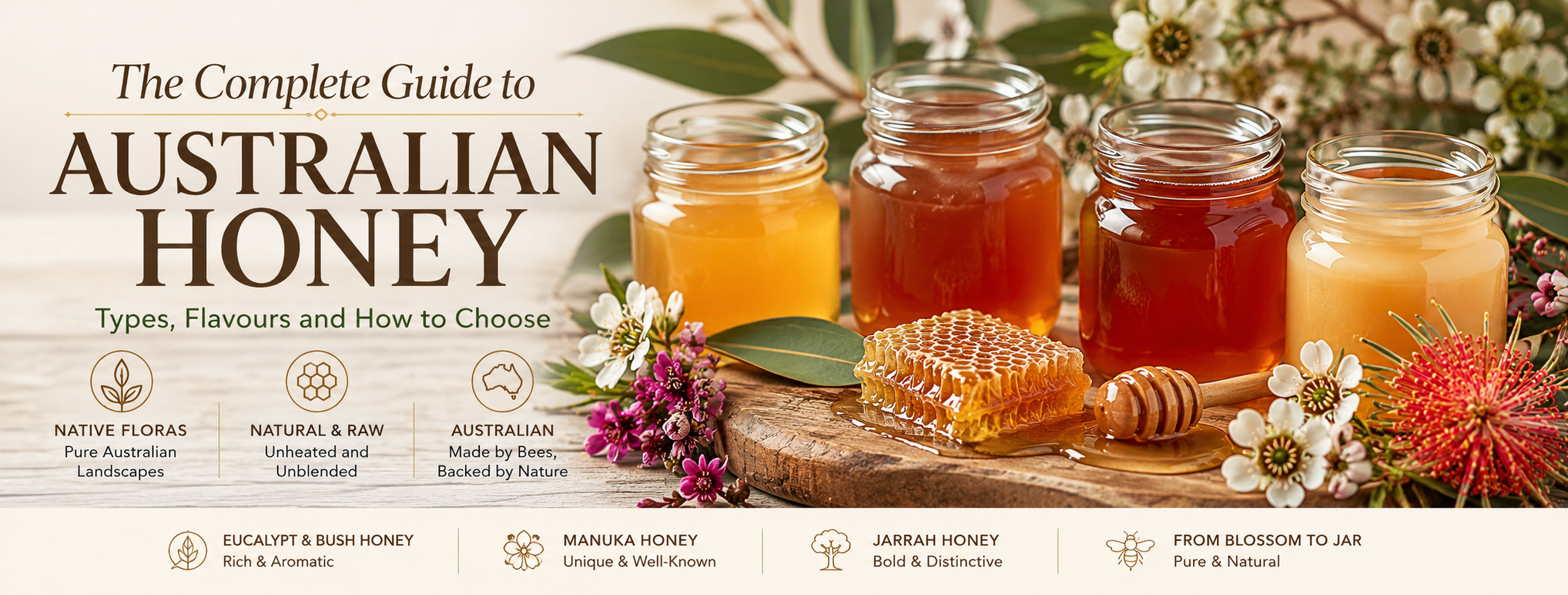
Australian honey is shaped by native forests, flowering trees, coastal plants, changing seasons and the work of Australian beekeepers. This wide range of floral sources means one honey can be light and delicate while another may be dark, rich, woody or caramel-like.
Western Australian Jarrah honey.
Contents
What is Australian honey?
Why Australian honey is distinctive
How honey moves from blossom to jar
Main types of Australian honey
Monofloral, multifloral and blended honey
Raw, filtered, liquid and creamed honey
Colour, flavour and texture
How Australian honey quality is assessed
Why honey crystallises
How to choose Australian honey
How to store honey
Frequently asked questions
What Is Australian Honey?
Australian honey is honey produced in Australia when honey bees collect nectar or permitted plant secretions, transform that material inside the hive, store it in honeycomb and allow it to ripen. The name describes the country of production, but it does not describe one single flavour, colour or texture.
A jar produced near coastal tea-tree habitat can be very different from honey gathered in a Western Australian Jarrah forest or an eastern Australian eucalypt woodland. Floral source is usually the strongest influence, but rainfall, soil, temperature, flowering intensity, hive location and harvest timing also affect the finished honey.
This natural variation is important when comparing products. Instead of judging a jar only by colour or price, look for its floral source, region, country of origin, net weight, processing description, grading information and supplier details. These details help explain what you are buying and how one honey differs from another.
Why Australian Honey Is Distinctive
[1] Many well-known Australian honeys are connected with eucalypt forests and other native ecological communities.
This diversity gives shoppers many flavour choices. Some honeys are pale, clean and gently floral. Others are amber, malty, woody, mineral-like or caramel-rich. Darker honey is not automatically better than lighter honey, and a thick honey is not automatically more authentic than a runny one. The most suitable choice depends on personal taste and intended use.
[1] Buying clearly labelled Australian honey can therefore support local supply chains and the beekeeping industry connected with those landscapes.
How Honey Moves from Blossom to Jar
The process begins when worker bees collect nectar from flowers. They carry it back to the hive, where it is transferred between bees, combined with naturally occurring enzymes and placed into honeycomb cells. Bees move air through the hive to reduce moisture, and mature honey is sealed with wax.
When the honey is ready, beekeepers remove the frames, uncap the wax and extract the honey from the comb. The honey may then be allowed to settle, strained to remove larger wax particles, filtered for a clearer appearance, gently warmed to assist handling, or creamed to create a smooth and spreadable texture.
These handling choices affect clarity, consistency and presentation. They do not change the plant source from which the nectar was collected, but they can influence how easily the honey pours, spreads and crystallises in the jar.
Main Types of Australian Honey
Eucalypt and Australian Bush Honey
Eucalypts are central to Australian honey production. Product labels may refer to Yellow Box, Grey Box, Red Gum, Ironbark, Stringybark, Blue Gum or other named eucalypt sources. Depending on the tree and region, these honeys can range from pale gold to deep amber and from mild sweetness to stronger woody or caramel-like flavours.
Bush honey usually means honey collected from several flowering plants in a natural Australian environment rather than from one clearly dominant floral source. It can be a practical everyday choice for toast, porridge, tea, dressings, marinades and baking.
Australian Manuka Honey
[2]
Manuka labels may display an MGO number. MGO refers to the stated concentration of methylglyoxal in milligrams per kilogram. Some jars may also display an NPA grade as another strength reference. These values help customers compare labelled strengths, but they should be considered together with the jar size, brand, origin and product description.
Australian Manuka honey collection includes a sequence of clearly labelled strengths, from introductory choices to premium and upper-range selections.
Western Australian Jarrah Honey
[3]
Jarrah flowering is variable and influenced by seasonal rainfall and spring warmth. This means production can differ between seasons. Some Jarrah products display a TA rating. TA means total activity and is used as a comparative laboratory grading reference for certain honey products.
Jarrah honey collection to compare TA-labelled options, jar sizes and product information.
Marri, Karri and Other Western Australian Honeys
Western Australia also produces honey from Marri, Karri, Wandoo, Blackbutt, Banksia, Hakea and other native plants. Marri honey is often selected for a balanced flavour, while Karri honey may be lighter and more delicate. Exact colour, aroma and texture can change naturally between harvests.
Australian Native Stingless Bee Honey
[4] Buyers should therefore read native bee honey labels separately rather than assuming it has the same composition or texture as ordinary table honey.
Monofloral, Multifloral and Blended Honey
Monofloral honey is mainly associated with one dominant floral source, such as Jarrah or a particular eucalypt. This does not mean every bee visited only one species. Bees forage freely, but one nectar source is dominant enough to give the honey its recognised botanical character.
Multifloral honey comes from several nectar sources. It may be labelled as bush honey, wildflower honey or according to a region. Because the available flowers change through the season, multifloral honey can have a layered flavour and may vary between batches.
Blended honey can mean honey from different batches or floral sources combined to create a more consistent taste or texture. This is different from adding another sweetener. When shopping, read the country-of-origin statement and ingredient information so you understand what the jar contains.
Raw, Filtered, Liquid and Creamed Honey
Honey labels often use processing and texture terms. These words can be helpful, but producers may use them differently, so the product description remains important.
1. Raw honey: commonly used for honey that has received minimal processing and has not been exposed to high heat. The word raw does not identify a floral source or activity grade.
2. Filtered honey: passed through finer filtration to remove small particles and create a clearer appearance.
3. Strained honey: passed through a coarser screen to remove larger wax particles while retaining a less polished appearance.
4. Liquid honey: packed in a pourable state. Liquid honey may still crystallise naturally later.
5. Creamed honey: processed to encourage small, controlled crystals, creating a smooth and spreadable texture.
6. Comb honey: presented in the beeswax comb rather than fully extracted and packed as liquid honey.
What Determines Honey Colour, Flavour and Texture?
The nectar source is usually the strongest influence on flavour and colour. Pale honey may taste light, floral or clean, while darker honey may have richer malt, caramel, woody or mineral-like notes. Colour alone does not prove quality, purity or strength.
[5]
Two jars sold under the same floral name may therefore show small differences in colour, viscosity or crystallisation. This is expected in a natural agricultural food, provided the product is accurately labelled and handled appropriately.
How Australian Honey Quality Is Assessed
Honey quality cannot be judged only by colour, thickness or sweetness. Laboratory testing may examine moisture, sugar composition, acidity, electrical conductivity, diastase activity and hydroxymethylfurfural, commonly shortened to HMF. These measurements help describe composition and handling.
[5] This type of research supports future work on quality standards, regional characteristics and honey integrity.
Premium honey may also carry a grading system connected with a particular product category. Manuka honey may display MGO or NPA, while some Jarrah honey displays TA. These systems describe different measurements and should not be compared as though the numbers are interchangeable.
Seasonality and Natural Batch Variation
Honey is produced from flowering plants, so every harvest is influenced by rainfall, temperature, flowering intensity, hive location and the mix of plants available to the bees. A named variety can therefore show natural differences in colour, aroma and thickness from one season to the next.
Some producers combine compatible batches to create greater consistency. Others retain the individual character of a particular harvest. Neither approach is automatically better. The important factors are clear labelling, traceable sourcing and a product that matches its description.
Why Does Honey Crystallise?
Crystallisation is a natural physical change in which some dissolved sugars form crystals. It does not automatically mean the honey is spoiled, adulterated or low quality. Some floral varieties crystallise quickly, while others remain liquid for longer because their sugar balance is different.
Crystallised honey can be eaten as it is and is often easier to spread. To soften it, place the closed jar in warm water and allow it to warm gradually. Avoid boiling the honey or exposing a plastic jar directly to excessive heat.
How to Choose Australian Honey
The best honey depends on how you plan to use it. A high grading number is not automatically the right choice for every buyer. Consider flavour, origin, jar size, unit price, presentation and intended use.
| Buying purpose | What to look for |
|---|---|
| Everyday breakfast and drinks | A flavour you enjoy, a convenient jar size and suitable pourability |
| Cooking and baking | Balanced flavour, suitable quantity and good value by weight |
| Trying premium honey | Clear floral source, origin, grading information and a smaller trial jar |
| Gift or hamper | Premium presentation, distinctive Australian origin and an appropriate floral story |
| Comparing Manuka honey | MGO or NPA rating, brand, jar size and country of origin |
| Comparing Jarrah honey | TA rating, Western Australian origin, jar size and supplier information |
Also compare the price by weight. A lower jar price does not always mean a lower unit cost, and a multipack can offer different value depending on the discount and intended use.
How to Store Honey
Keep honey tightly closed in a clean, dry cupboard away from direct sunlight and excessive heat. Use a clean, dry spoon to avoid introducing moisture or food particles into the jar.
Ordinary honey generally does not require refrigeration, and colder temperatures can encourage faster crystallisation. Always follow the storage instructions printed on the product label.
Honey is not suitable for children under 12 months of age.
Ways to Enjoy Australian Honey
1. Drizzle it over toast, pancakes, porridge, yoghurt or fresh fruit.
2. Stir it into warm tea after the drink has cooled slightly.
3. Mix it into salad dressings with olive oil, mustard and vinegar.
4. Add it to marinades and glazes for vegetables, chicken or pork.
5. Use it in baking where honey complements oats, nuts, fruit and spices.
6. Pair lighter honey with soft cheese and darker honey with stronger aged cheese.
7. Include a premium Australian honey jar in a food gift or corporate hamper.
Authenticity, Origin and Labelling
When purchasing honey online, look for a clear product name, net weight, country-of-origin statement, supplier information, lot or batch details where applicable, and grading information that is explained rather than shown without context.
For premium varieties, confirm whether the displayed number refers to MGO, NPA, TA or another grading system. These systems are not interchangeable, so direct number-to-number comparisons can be misleading.
Evithi About page.
Explore Australian Honey at Evithi
Compare clearly labelled Australian honey products by floral source, strength, jar size and pack quantity.
Browse Jarrah Honey
Evithi honey blog.
Frequently Asked Questions
What is the most popular type of Australian honey?
Eucalypt and mixed bush honeys are widely used as everyday table honey. Australian Manuka and Jarrah are prominent premium categories because their floral origin and grading information allow more detailed comparison.
Is darker honey better than lighter honey?
Not necessarily. Colour mainly reflects the floral source and natural composition. Choose honey according to flavour, origin, intended use and clearly stated product information rather than colour alone.
Is crystallised honey still good?
Crystallisation is a normal change in many honeys. The honey can be eaten in its crystallised state or gently warmed in a water bath when a more liquid texture is preferred.
What is the difference between Manuka and Jarrah honey?
They come from different trees and regions and commonly use different grading references. Australian Manuka is associated with Leptospermum species and may display MGO or NPA. Jarrah comes from Eucalyptus marginata in Western Australia and may display TA.
What does raw Australian honey mean?
Raw commonly describes honey that has received minimal processing and has not been exposed to high heat. Check the producer’s explanation because processing practices can differ.
Should honey be refrigerated?
Ordinary honey usually does not require refrigeration. Store it tightly closed in a cool, dry cupboard away from direct sunlight and follow the label directions.
Can babies eat honey?
No. Honey is not suitable for children under 12 months of age.
Continue Exploring Honey
Evithi blog index for additional guides and comparisons.
Official Sources and Further Reading
Australian Government Department of Agriculture — honey bees and Australian honey production
AgriFutures Australia — guide to Australian Leptospermum trees and honey
Western Australian DPIRD — premium Western Australian honey products
Food Standards Australia New Zealand — Australian native bee honey
AgriFutures Australia — composition of Australian honey
Important note: Honey is a food. It is not intended to diagnose, treat, cure or prevent disease. Honey is not suitable for children under 12 months. Seek professional advice for dietary, allergy or health-related concerns.
Leave A Reply