
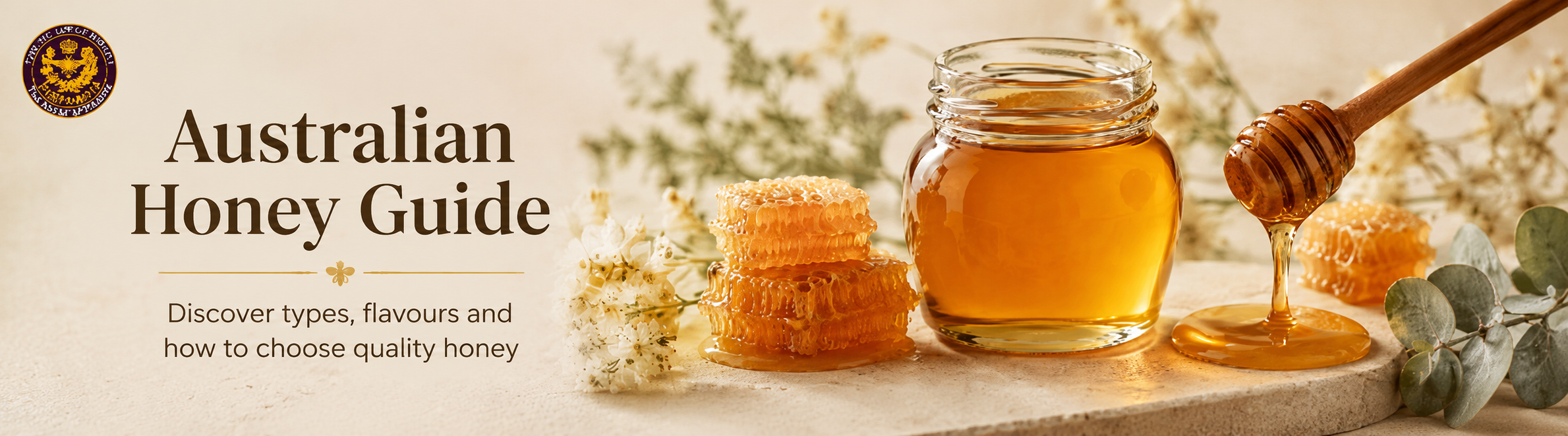
Raw honey generally means honey that has received minimal processing after it is removed from the hive. It may be strained to remove larger pieces of wax or other hive material, but it is commonly sold without heavy filtration or exposure to high processing temperatures.
The word “raw” does not identify one particular flower, flavour, colour, country of origin or laboratory grade. Raw Australian honey may come from eucalypt forests, mixed bush flowers, Australian Manuka plants, Jarrah trees or other floral sources.
This Australian buyer’s guide explains how raw honey differs from strained, filtered, liquid and creamed honey, why it may look cloudy or crystallise, what to check on a label and how to store it correctly.
Contents
What is raw honey?
How honey moves from hive to jar
Raw, strained and filtered honey compared
Raw honey versus processed honey
Why raw honey may look cloudy
Why raw honey crystallises
Colour, flavour and texture
Quality, authenticity and labelling
How to choose raw Australian honey
How to store raw honey
Frequently asked questions
What Is Raw Honey?
Raw honey is a commonly used description for honey that has been handled with relatively little processing after extraction from the comb. In practical terms, this often means the honey has been strained to remove larger wax particles and debris but has not been heavily filtered or exposed to high temperatures for long periods.
There is no single appearance that proves a honey is raw. Raw honey can be clear or cloudy, runny or thick, pale gold or dark amber. Its appearance depends on the floral source, natural sugar balance, moisture, temperature, storage time and the way the producer handles the honey.
The word “raw” also does not mean the honey came from one flower. A raw honey can be monofloral, meaning one floral source is dominant, or multifloral, meaning nectar came from several flowering plants.
When buying online, read the producer’s explanation rather than relying only on the word “raw”. One producer may use the term for strained honey, while another may use it for honey that has been lightly filtered or gently warmed to assist filling.
How Honey Moves from Hive to Jar
Honey begins when worker bees collect nectar from flowers. They carry the nectar back to the hive, where it is transferred between bees, combined with naturally occurring enzymes and stored in honeycomb cells.
Bees move air through the hive to reduce moisture. When the honey is mature, the cells are capped with wax. Beekeepers later remove suitable frames, uncap the wax and extract the honey from the comb.
After extraction, the honey may be allowed to settle so air bubbles and small wax particles rise to the surface. It may then be strained, filtered, gently warmed for easier handling, creamed to control crystal size or packed with minimal further processing.
These handling choices influence clarity, pourability and consistency. They do not change the original floral source, but they can affect how the honey looks and behaves in the jar.
Raw, Strained and Filtered Honey Compared
The terms raw, strained and filtered describe different aspects of handling. They can overlap, so a honey may be both raw and strained.
| Term | What it commonly means | What you may notice |
|---|---|---|
| Raw honey | Minimally processed honey that has not been exposed to high processing temperatures | Natural variation in clarity, texture and crystallisation |
| Strained honey | Honey passed through a coarse screen to remove larger wax particles | May retain a less polished or slightly cloudy appearance |
| Filtered honey | Honey passed through finer filtration to remove smaller particles | Usually clearer and more visually consistent |
| Creamed honey | Honey processed to encourage very small, controlled crystals | Smooth, thick and spreadable texture |
A clearer honey is not automatically better, and a cloudy honey is not automatically raw. The producer’s processing description provides more useful information than appearance alone.
Raw Honey Versus Processed Honey
“Processed honey” is a broad phrase rather than one single production method. Almost all jarred honey goes through some handling, even when that handling is limited to extraction, settling, straining and packing.
A producer may gently warm honey because cold or crystallised honey can be difficult to pump or fill into jars. Another producer may filter it for a clearer retail appearance. These steps do not automatically mean the honey has been mixed with another sweetener or is no longer genuine honey.
[1] This is separate from normal processing such as straining, filtering or controlled warming.
The best comparison is therefore not simply “raw equals good” and “processed equals bad”. Instead, compare origin, floral source, ingredient information, processing explanation, traceability and how you intend to use the honey.
Why Raw Honey May Look Cloudy
Raw or lightly strained honey may contain tiny air bubbles, microscopic wax particles, pollen and early sugar crystals. These can give the jar a cloudy or less polished appearance.
Cloudiness can also appear as crystallisation begins. Fine crystals scatter light, causing the honey to look pale, creamy or opaque even when it was previously clear.
A cloudy appearance alone does not prove that the honey is raw, and it does not automatically indicate spoilage. Clear honey can also be minimally processed, while cloudy honey may have become cloudy simply because of temperature or storage time.
Why Raw Honey Crystallises
Crystallisation is a natural physical process in which some dissolved sugars form crystals. It is common in honey and does not automatically mean the product is spoiled, adulterated or low quality.
The rate of crystallisation is influenced by the natural ratio of glucose to fructose, moisture, temperature, fine particles and storage time. Some floral varieties crystallise quickly, while others remain liquid for much longer.
[2] This variation helps explain why Australian honeys do not all behave in the same way.
Crystallised honey can be eaten as it is. To return it to a more liquid texture, place the closed jar in warm water and allow it to soften gradually. Avoid boiling the honey or exposing a plastic jar directly to excessive heat.
Raw Honey Colour, Flavour and Texture
The floral source is usually the strongest influence on colour and flavour. Raw Australian honey can range from pale straw and bright gold to deep amber or dark brown.
Lighter honey may taste clean, delicate or floral. Darker honey may have stronger caramel, malt, woody or mineral-like notes. These descriptions are general only because individual batches and personal taste vary.
Texture can change with temperature and time. Warm honey usually flows more easily, while cooler honey becomes thicker. Crystallised honey may feel smooth, fine, coarse or grainy depending on the size of the crystals.
Colour does not prove purity, raw status or activity grade. A dark honey is not automatically stronger than a light honey, and a thick honey is not automatically more authentic than a runny honey.
Quality, Authenticity and Labelling
There is no reliable kitchen test that can prove whether honey is raw or genuine. Water tests, thumb tests, flame tests and assumptions based on crystallisation can produce misleading results.
The most useful buying information comes from the label and supplier. Look for a complete product name, net weight, country of origin, floral source where stated, supplier details, lot or batch information where applicable and a clear explanation of processing.
Raw does not mean unregulated or unlabelled. Food sold in Australia must still comply with applicable food standards and labelling requirements.
How to Choose Raw Australian Honey
The best raw honey depends on how you plan to use it and which flavours you enjoy.
1. Check the origin: look for a clear Australian country-of-origin statement and supplier information.
2. Read the processing description: confirm whether the producer describes the honey as strained, filtered, gently warmed or minimally processed.
3. Choose a floral source: compare mixed bush honey with named floral varieties such as Australian Manuka or Western Australian Jarrah.
4. Compare jar size: a smaller jar may suit first-time tasting, while a larger jar may offer better value for regular use.
5. Compare price by weight: the cheapest jar is not always the lowest cost per 100g.
6. Expect natural variation: colour, thickness and crystallisation may change between batches.
7. Avoid unsupported promises: choose products with clear food-focused information rather than broad treatment or disease claims.
The Complete Guide to Australian Honey.
How to Store Raw Honey
Keep raw honey tightly closed in a clean, dry cupboard away from direct sunlight and excessive heat. Use a clean, dry spoon so that moisture, crumbs or other food are not introduced into the jar.
Ordinary refrigeration is generally unnecessary and can encourage faster crystallisation. Follow any storage instructions printed on the product label.
Natural changes in colour, thickness and crystal formation can occur during storage. These changes are different from contamination, fermentation or packaging damage.
[3]
Explore Australian Honey
Compare clearly labelled Australian honey by floral source, grade, jar size and pack quantity.
Browse Australian Jarrah Honey
Evithi About page.
Frequently Asked Questions
Is raw honey completely unprocessed?
Not necessarily. Raw honey is usually extracted, settled and strained before packing. The term generally means minimal processing rather than no handling at all.
Can raw honey be filtered?
Some producers may use light filtration and still describe the product as raw. Read the individual processing description because practices and terminology can differ.
Why is raw honey cloudy?
Cloudiness may come from tiny wax particles, pollen, air bubbles or early sugar crystals. Appearance alone cannot prove that honey is raw.
Does raw honey crystallise?
Yes. Crystallisation is a normal physical change influenced by natural sugar balance, temperature, moisture and storage time.
Is crystallised raw honey still usable?
Yes, when the jar is otherwise sound and uncontaminated. It can be eaten in its crystallised state or gently softened in warm water.
Is dark raw honey better than light raw honey?
Not necessarily. Colour mainly reflects the floral source and natural composition. Choose according to taste, origin and intended use.
Should raw honey be refrigerated?
Usually no. Store it tightly closed in a cool, dry cupboard and follow the label directions.
Can babies eat raw honey?
No. Raw and processed honey are both unsuitable for children under 12 months of age.
Official Sources and Further Reading
Australian Government Department of Agriculture — honey and food adulteration
AgriFutures Australia — composition of Australian honey
Healthdirect Australia — honey and the under-12-month infant botulism rule
Important note: Raw honey is a food. It is not intended to diagnose, treat, cure or prevent disease. Honey is not suitable for children under 12 months. Seek professional advice for dietary, allergy or health-related concerns.
Leave A Reply